And this is my passion, movement.

I attended a three-day seminar this weekend, taught by Dr. Craig Liebenson, a great thinker and leader in my profession.  It was entitled “Prague School to Athletic Development; Functional Assessment and Core Training.”  This is core rehabilitation at its finest.

But what really struck me about the course was the passion it brought about in me.  Not passion about core rehab necessarily (although I did learn a lot on that front and will certainly be bringing some new and refined tools to my practice life), but rather, passion about movement.  I believe in movement.  I believe so deeply, so rooted in my fundamental values and understanding and conviction, that we were made to move.

The first topic Dr. Liebenson spoke about was what he called an “Inactivity Crisis.”  Society is in the midst of an inactivity crisis, complete with sitting to commute, sitting at work, dropping physical activity levels, soaring obesity and heart disease and back pain.  “Use it or lose it,” he said, referring to our body’s movements, and my heart and my mind and every part of me was silently nodding, screaming, jumping “EXACTLY!”

I can’t state it more simply than that.  We need to move.  And this is my passion, movement.

IMG_3099

I plan vacations around outdoor activities.  I find a gym in every city I visit.  I enter races and competitions because I like the challenge.  I would rather go for a walk than watch a movie.  My favourite girl’s nights involve a workout.  I chose to become a chiropractor because I wanted to work with athletes.  I believe so strongly in movement and fitness and physical activity that I’ve centered my whole life around it.  Movement is my common thread.

Kids who are more active get better grades.  Adults who are more active lower their risk of cardiovascular disease, obesity, and depression.  Seniors who are more active have fewer falls, take fewer meds, and have a better quality of life.  Movement is a lifestyle, not 30-minutes three-time-a-week.  It’s more than that.  It’s a choice, a necessity, a responsibility.

I want my body to age well.  When my crow’s feet deepen and my skin sags, I want to be able to get myself up off the couch.  I want to be able to lift my own groceries and make my own meals and play with my grandchildren.  And while movement isn’t the be-all-end-all guarantee that I will get to do these things, it’s a step in the right direction.

So how can I end this post without sounding like I’m ranting?  Like I’m pointing a finger, being holier-than-thou, and standing on a soapbox?  Perhaps I can’t.  Perhaps I’ve already  made you uncomfortable, made you introspect, made you think.  If so, I’ve done my job.  I’ve always said that this blog comes from my genuine, heartfelt beliefs.  And I genuinely believe in movement.

“Just a few generations ago, physical activity was a constant part of daily life. Now we’ve done away with it so thoroughly, physical inactivity actually seems normal. The social and economic costs and consequences are unsustainable.” ~designedtomove.org

The End.

But you should watch this video:  http://designedtomove.org/.

I Can’t Think of a Better Reason

I’ve been running a bit more lately, as I’ve registered for two half marathons this Spring.  My first race is on Sunday, March 6th- it’s the Chilly Half Marathon in Burlington, and it’s got a start line that I can now walk to, since my family’s move this past Fall.  I registered myself based largely on that fact alone; a pedestrian life makes me happy.  My second race is at the end of May- another half marathon, this time a women’s-only in Toronto, that I’ve entered with two dear friends.

But as the date of my first race draws closer and my confidence starts to dip, as it always does before a race, I am shifting my approach and calling it a training run instead of a race.  I’ve been less than perfect with my long runs, and since I’m only running once/week, that’s an important piece that’s been neglected.  I have been consistently going to the gym four times per week, and throwing in some hot yoga for good measure, but the actual running mileage on my legs is very low.  When I was in my prime long-distance-running years, I was logging 100km+ each and every week.  I ran for the University of Calgary’s cross-country and track & field teams, and following that, running helped me to channel my energy through the intense demands of my Chiropractic degree.  I got on some podiums, set some personal bests, and even won some money.  I ran against the clock, against my strive for perfection, against my constant drive to be faster and better and better and better.

I still approach most things in life like this, and I’m nothing if not self-motivated.  But now I’ve learned to control it.  And the deep, dark truth is that running, or more accurately, racing, doesn’t always bring out the best of my psyche.  There’s a fine line where my self-imposed pressure can become unhealthy, and black-and-white race times have the ability to play with my head.

I had my first child in 2009 and ran a 10-mile race ten weeks post-partum.  In hindsight, this was a terrible decision, as my body was completely unprepared for that intense energy demand.  But I needed to get back out there, I needed to feel like me again, and a big part of me is running.  And from this race, I gained a positive despite the physical negative; that 10-miler changed how I saw myself.  It showed me that running can be a subtitle in the story of my life, rather than the headline.

Throughout the past seven years, the expectations I’ve placed on myself and my running has exceedingly changed.  I’m realizing that people don’t care about my race times.  People don’t care if I win my age group or run a four-minute kilometre or (gasp!) have to slow down.  People don’t care that my half marathon will be more than twenty minutes slower than my personal best and that it will likely take me three full days to recover.

And the most important person that doesn’t care about this stuff anymore is me.

I run to focus, I run to de-stress, I run to think.  I run because I LOVE TO RUN.

I can’t think of a better reason.

IMG_3008

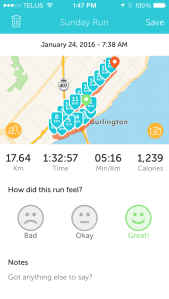
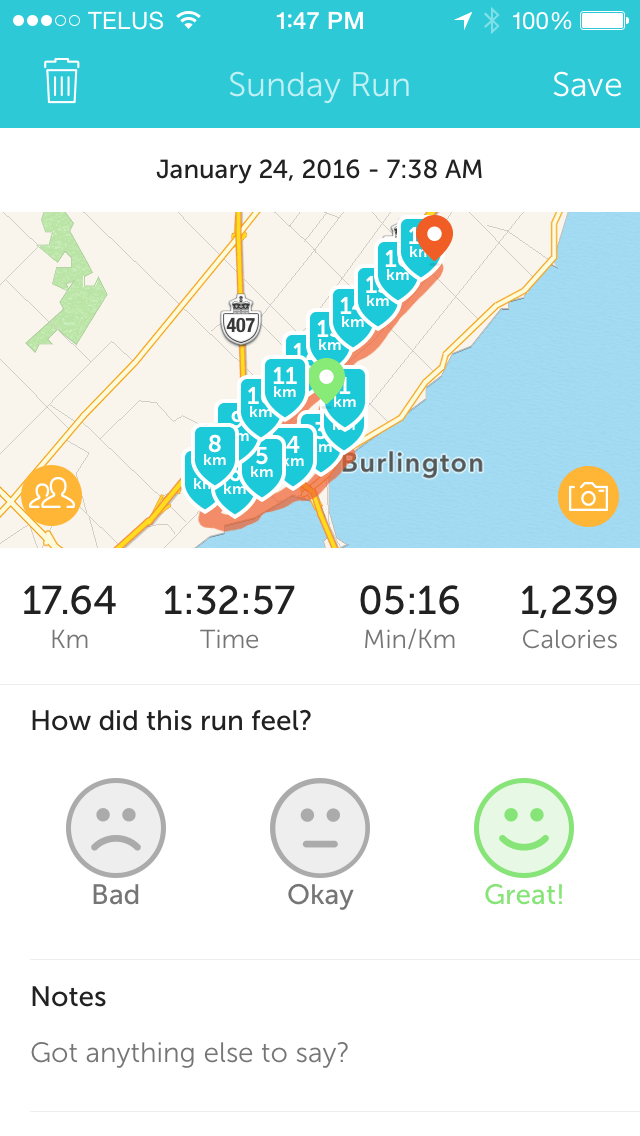
This is my run from two days ago.  It’s probably ten minutes slower than it would’ve been in years past, and I’m okay with that!


Straw. Camel’s back.

In my practice, I often ask the question, “Was there an incident that started your pain?  Or did it just creep up on you?”  The answer is very often, “Well, it could be (insert activity here), but I’ve been doing that for years, so I don’t think that’s it.”  But, perhaps, that’s exactly it.

Tissues have a certain amount of force they can withstand before they become injured/dysfunctional/irritated.  This is called tissue tolerance.  The end result of too much force is usually pain.  You see, pain is often the last symptom to appear, not the first.  So, prior to your experience of pain, damage has been done behind-the-scenes for awhile.  If you are body-aware, you may have already noticed this in yourself; perhaps your first perception of a symptom was tightness or decreased strength or lack of range of motion.  But the pain didn’t follow until later.

This process gives us some valuable insights into treatment.  At least, that’s how I see it, and that’s how I treat it.

First, pre-pain symptoms (the above-mentioned tightness, strength, and range of motion) should be watched for and can be used as warning signs to prevent further injury.  Maybe these pre-injury symptoms can be used as healthy reminders to improve your mobility, add in some recovery time, or focus on your nutrition.  Maybe they cause you to re-check your workplace ergonomics or your sleeping positions or your form in the gym.  Maybe they are a signal that your body needs some hands-on treatment.  Listen to those signals, and heed their warnings.

It is much easier to prevent an injury than it is to fix an injury.

Second, just because the pain has disappeared, doesn’t mean that the affected tissues are back to their normal pre-injury state.  This helps to guide my decisions for a patient’s return to activity and give appropriate movement guidelines.  So when I tell you to stop box jumps for the time being, or to raise your computer screen, there’s a method to my madness and science in my reasoning.

The bottom line is this: if you’ve been dead-lifting with a rounded spine for months, or you’ve been sitting at a desk job for years, or you’ve been hunched on your couch with your iPad and “it’s never bothered you before,” doesn’t mean that it won’t bother you now.

Straw.  Camel’s back.  Remember?

straw-camel