F*** Cancer. Enough.

No really.  F*** it.  I’ve had enough of hearing that yet another friend is fighting this battle, had enough of cancer attacking young, strong, wonderful people, had enough of this awful disease.  Had enough.  Enough.

Last week alone, a friend’s husband lost his battle with cancer, another friend was diagnosed, and a third friend discovered a second cancer site.  And that’s just last week, just within my circle of friends and acquaintances.  Enough.

Cancer’s reach is widespread and non-discriminate.  More than 187 000 Canadians got a cancer diagnosis last year, and 40% of us can expect to get diagnosed with cancer at some point in our lives.  40%, 2 in 5, almost half.  Enough.

So what can we do?

We can help them fight.  We can fight with our friendship, our homemade soup, and our I’m-here-for-you-hugs.   We can fight with our screening tools, our risk-factor minimization, and our spread of awareness.  We can fight with our wallets, our research dollars, and our fundraising efforts.  We can help them fight until it’s enough.

Canadian-Cancer-Society

Here are a few fundraising efforts near and dear to my heart.  Please grab your credit card and click on the links.  Enough.

Love the Snatch Foundation for Cervical Cancer Research

Kim’s Ride to Cross Out Cancer

Burlington’s Relay for Life


“You’re Not Ready Yet”

An athlete who returns to training fearful about re-injury is an athlete that is more prone to re-injury.

Think about that statement for a minute.  Now why would I choose to write about this topic?  Because it’s something that I deal with almost daily in my practice.  If you are reading this as a patient, perhaps you can relate, and if you are reading this as a practitioner that works with athletes, most certainly you can relate.

photo-13

My knee surgery- March/2005

But, you see, this is one of the reasons that I LOVE working with athletes… I love their I-cannot-rest-I-need-to-get-back-to-training attitude.  Because I’m like that too.  I’m one of them.  I’m the basketball player who broke her thumb and finished the tournament (ask my parents).  I’m the ball-hockey player who tore her ACL and kept training for a marathon (ask my friends).  I’m the runner who sprained her ankle, taped it up, and competed anyways (ask my husband).  Were these smart decisions?  Probably not.  Would I choose differently now?  Also probably not.

But….. and this is a big but, a huge however, and an extreme nonetheless…. getting back to training before your injury is healed is not the best choice in the long run.  Let me say that again in a different way: if you injure a structure in your body and that structure is not healed before you resume training, you will re-injure yourself.  And, most likely, it’ll be worse the second time around.

That’s where the fear component comes into play.  Remember my original statement?  An athlete who returns to training fearful about re-injury is an athlete that is more prone to re-injury.  I believe that athletes know their bodies far better than I, their healthcare practitioner, do.  Sure, I know the anatomy, I understand the biomechanics, and I can draw upon research studies and my professional experience, but I don’t really know what they’re feeling.

I’m not referring to their fear of the consequences of re-injury (ie. the baseball player who worries about missing the rest of his season, the Crossfitter who worries about completing the next Open workout, the runner who worries about finishing her next marathon)- those are normal, understandable, expected fears.  I am talking about the fear, the apprehension, the tentativeness, the uneasiness, the doubt that can creep in under the surface of it all and whisper to the athlete “you’re not ready yet.”  That’s where re-injury happens.

To my athletes: if I give you the green light to resume training and fear murmurs “you’re not ready yet,” tell me.  And I will agree.

everyday get better


A Healthy Back

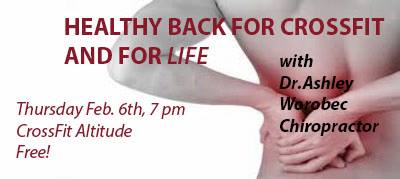
“A Healthy Back: for Crossfit and for LIFE”….. this is the presentation I’m doing at Crossfit Altitude on Thursday evening, (February 6th at 7:00pm).  It’s going to be a hands-on, active-participation, lots-of-questions-and-answers event and I’ve capped the registration at 20 people so that we can have some great learning opportunities and hopefully some ‘a-ha’ moments.

The reason that I wanted to host this talk is that I’ve seen an increase in the number of lower back injuries in my practice as of late.  “But you’re a chiropractor” you say, “don’t you always see lower back injuries?”  The answer is yes, but my practice is centred around athletes and active people, so I see a whole host of other injuries as well; from ankle sprains and elbow pain to migraine headaches and knee problems.  Unfortunately, back injuries seem to have claimed the top spot for the past few months.  So the point of this event is education……. leading to prevention.

What’s the plan, you say?Anatomy-of-the-back

  • We’re going to talk about anatomy.  If you don’t understand the components of your lower back, how can you understand how to keep it healthy?
  • We’re going to talk about the three most common back injuries that I see in my practice, and how they relate to Crossfit specifically.
  • We’re going to move; we’re going to stretch, and strengthen, and talk about tips and suggestions that you can implement into your everyday life.
  • We’re going to have lots of time to chat; I want participants to go home with all of their back pain/injury/health questions answered.

One of my very first blog posts, that you can view here, was surrounding the misconception that Crossfit causes injuries.  I argue that injuries are simply a part of sport, and that the benefits of an active lifestyle far outweigh the risks.  I feel very passionate and definitive about this statement.

This event is currently full, but if the interest is there,  I would be happy to host another one.  Or to come and talk to your group about injury prevalence and prevention, specific to your situation.

As long as we are using our bodies, we need to take care of them!

See you on Thursday.

6a011571564ab3970c01a3fc8da203970b-500wi

Here’s the associated blurb:

Crossfit does not cause lower back injuries, but poor form and weak mechanics do! Do you want to learn how to PREVENT and FIX common lower back injuries? Do you want to avoid that nagging post-deadlift ache? That chronic prolonged-sitting pain? That constant I’m-sore-until-I-warmup discomfort? Then come and join Dr. Ashley Worobec as she talks about common lower back injuries, how to prevent them, and how to fix them! This will be a hands-on active-participation seminar, so come dressed for movement! You will go home with a new appreciation of your lower back and some tips and tricks to keep it healthy and strong so that you can continue to Crossfit (and live) pain-free.