The Art of Humility

  • Humility.  hu-mil-i-ty. (hyoo-mil-i-tee).  Noun.  The quality or condition of being humble; modest opinion or estimate of one’s own importance, rank, etc.

When I think of the values I want to instill in my children, humility ranks near the top of the list.

There are two people in my life who come to mind when I think of humility, or in their case, a lack thereof.  Both of these people talk more than listen, brag more than compliment, and gloat more than praise.  Their arrogance and showmanship is distasteful, off-putting, and often times insulting.  But as I thought about it, I realized they’re patting themselves on the back because they’re worried no one else will.  Insecurity and lack of humility go hand in hand.  If a person is not secure with themselves, they have to broadcast their accomplishments for all to hear, in the hopes that they’ll feel better about themselves.

This is where my parenting mission starts.  To instill humility, I must instill confidence.  To instill humility, I must instill pride.  To instill humility, I must instill self esteem.

“Do you wish to be great? Then begin by being.

Do you desire to construct a vast and lofty fabric?

Think first about the foundations of humility.

The higher your structure is to be, the deeper must be its foundation.”

~Saint Augustine

So let’s go build foundations for our kids.  Deep ones.  So that they may be accomplished and humble.


My 6-month-old loves chicken

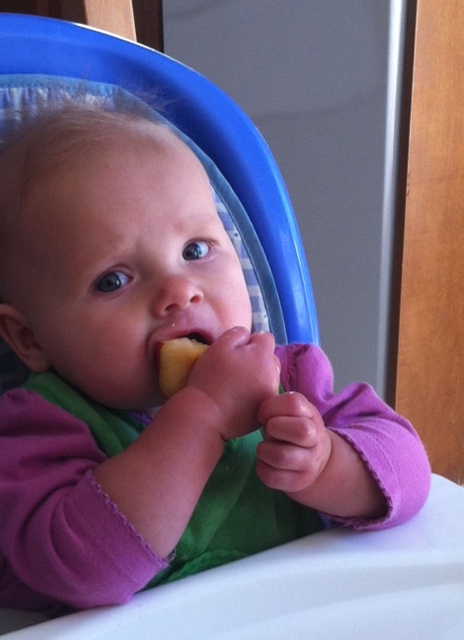
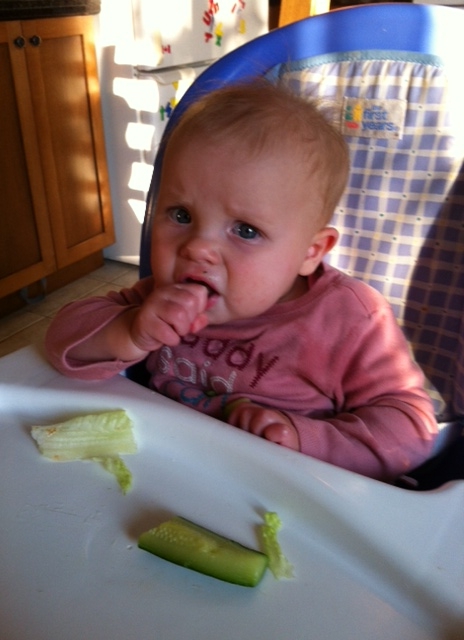
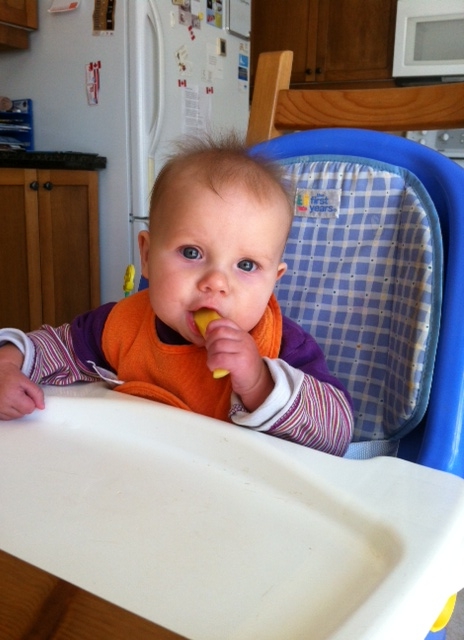
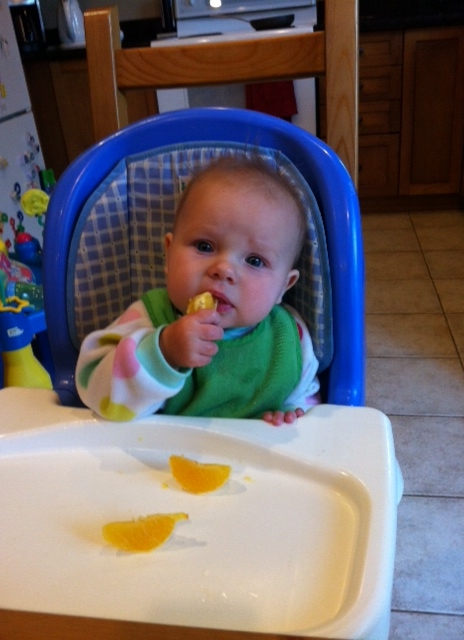
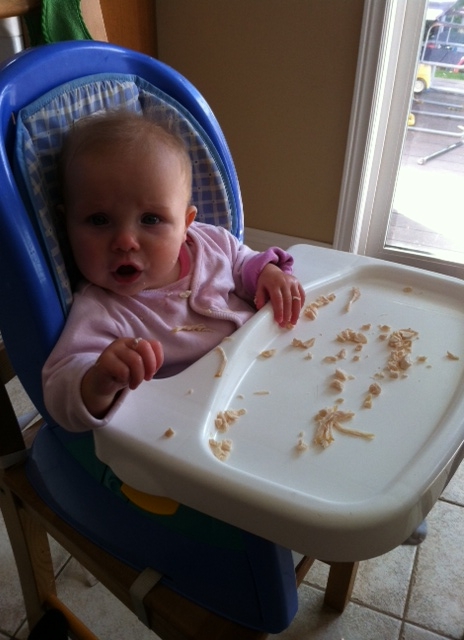
My six-month-old loves chicken.  And peaches and tomatoes and oranges and zucchini and plums.  No purees, no spoons, no time-consuming struggles to get her to eat.  Why, oh why, didn’t I use this method with my son?  If I’d only known!

This self-feeding approach is known in parenting circles as Baby-Led Weaning (BLW).  That’s a bit of a misnomer, as I don’t plan on weaning her anytime soon- I like to think of it as Baby-Led Feeding.  You give your baby food.  Real food.  And your baby learns to eat it.

I love it because:

  • It’s easy.  Step 1) Give food.  Step 2) Watch baby eat food.
  • It makes sense.  Throughout history, generations of parents have fed their children table food, rather than pre-packaged, pureed medleys.  Little cavemen babies were given a drumstick to gnaw on, not a jar of turkey and green bean mush.  Within my ‘crunchy hippie’ style of parenting, the natural feel of baby-led weaning fits the bill.  And at six months, children are physically able to self-feed, so it stands to reason that they can be given the chance to do so.
  • Babies learn to chew their food first, and swallow their food second.  This is contrary to the learn-to-swallow-first-and-learn-to-chew-second traditional approach of spoon-feeding purees.
  • It aligns with the World Health Organization and Health Canada recommendations that an infant’s primary source of nutrition before the age of one should be breastmilk or formula.  Food at this age is more about learning the process of eating, rather than worrying about the quantity they consume.
  • I’m hesitant to introduce grains to my daughter because her negative reactions when I eat wheat (here is my Blog about that!).  Starting with meat, veggies, and fruit seems like a logical beginning.

So how do you implement this approach?

  • Get used to answering questions from curious friends and family.  An atypical approach, baby-led weaning is not yet conventional, so people are going to want to know why your baby is nibbling on a strip of flank steak.
  • Buy an easy-to-clean highchair.  It’s a messy endeavor, since your infant will have control over the food they eat, rather than food coming to them on a spoon.  While you’re at it, don’t worry about bowls and plates; they’re just asking to be thrown on the floor, along with the raspberries and salmon flakes.
  • As with the traditional baby-food approach, a hungry/tired baby will not respond well to table food- make sure your baby is well-rested and not famished when you’re introducing solids.
  • Allow your baby to put the food into their mouths themselves so that they can control how far it goes in.  Infants have a very powerful gag reflex and will quickly learn how to manipulate food properly to avoid their gag response.  Cut the food into manageable strips, as they do not yet have a pincer-grasp.
  • Do some research (you can find great resources at www.babyledweaning.com, www.wholesomebabyfood.momtastic.com, and www.youtube.com). Get comfortable with this approach.  And then dive in!

Apples…

Peaches…

Red pepper…

Zucchini and lettuce…

Mango…

Oranges…

And chicken!


Cancer is a Powerful Word

Let me tell you about some of the worst 6 hours of my life.

I took my six-month-old daughter to the doctor last week for her regular Well-Baby checkup.  Our Family Doctor, whom I adore, was busy, so it was his Physician Assistant (PA) student who did Casey’s Physical exam.  I was not impressed with the PA’s competence in conducting the exam, but didn’t press to see my doctor, as I know that my daughter is thriving and I have no concerns.  As we were leaving, the PA student mentioned that she’d like my doc to come in and re-examine Casey.  We waited 5-10 minutes, and she returned with a Resident doctor, who shut off the lights and shone his ophthalmoscope near Casey’s eyes.  Again, my spidey senses were tingling, since my daughter was watching her brother run around the exam room, her head on a swivel; not great conditions for conducting a thorough baby eye exam.  The Resident then says to me: “We are going to refer you to an Opthamologist.  We are concerned that she has a Retinoblastoma”.  My heart stopped.  As I know from Pathology and Histology classes in my Chiropractic training, a Retinoblastoma is a rapidly-developing cancer that forms in the cells of the retina, and is the most common eye cancer in children.  The Resident went on to tell me that it would be the Opthamologist ‘who would be performing the surgery’, so the next step would be to wait for the referral to go through.  I left the office stunned, a mixture of terror and despair building inside me as I tried to hide my tears and keep a brave face in front of my very-perceptive 3-year-old son.

As my panic-stricken brain began to process what was happening, I phoned my Optometrist in tears, looking for a second opinion.  Thankfully, they squeezed us in later that day, and my husband and I were both there to witness their thorough, complete exam- which included lots of distraction techniques and clever maneuvers with the ophthalmoscope to get a clear picture of a curious six-month-old’s retina.  Guess what?  SHE IS FINE.  No Retinoblastoma.  No concerns.  Without a doubt, she has two perfect little retinas.

In hindsight, I can see that it was PA and Resident examiner-error that raised the red flag during retinal testing.  And I am not upset by the information that was conveyed to me, I am upset at the manner in which it was presented.  Medical professionals have a lot of power tied to their words, and with that power comes responsibility.  It was the Resident’s responsibility to give me the full picture about Retinoblastoma’s rarity (1 in 15 000 live births), prognosis (95-98% cure rate), and differential diagnoses (examiner-error, congenital cataracts).  To tell a mother that her six-month-old may have cancer and then leave the room lacks empathy, accountability, and professionalism.  I’m happy to report that when my Family Doctor heard about what happened, he phoned me himself to apologize and use this as a learning experience for his staff- the exact outcome that I was hoping for, as I don’t want anyone else to experience the devastation that I felt that day.

So for 6 hours,  we thought our baby might have cancer.  And I can’t help but think of another mother out there who was given the same news that day, only to find out it was true.  I write this post for her, because for 6 hours I felt her pain, experienced her suffering, and understood her misery.  But we were pardoned.  We got lucky.  Our outcome was favourable.  And I wish the best for her too.

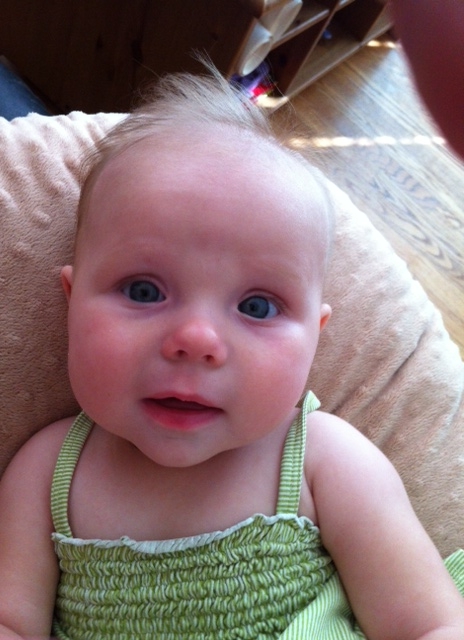
Cuddly little Casey!