Johnny Who?

Now that my first-born is in school, I realize that I’m having a hard time adjusting to city life.  Particularly the raising-kids part.  I grew up in small-town Alberta, where everyone knew everyone, and it was very common to not only know your teacher, but to also be going to school alongside their children.  My high school graduating class was somewhere around 70 kids, and we grew up together; we knew each other’s siblings and cousins, birthdays, after-school jobs, houses, and cars.  So I find it very strange to be dropping off my five-year-old for a full day of school, not knowing the parents or even the last names of his classmates.

I know, I know….. privacy concerns surround the release of personal information.  But really, what would I do if I knew the full names or, gasp!, the phone numbers of his classmates?  Google them?  Spam them?  Creep their Facebook pages?  Likely not.  In fact, all I would do is cultivate a community for my children.  I’d store the ‘last name’ details into my brain so that as my child continues at his Elementary School for the next nine years, I might run across those names at other extra-curricular or community activities and build a support system, a network, a village-to-raise-a-child.

I’ve become increasingly embedded into the Burlington community; I’ve got a profession that allows me to work with people from all walks of life and it’s a small enough city that I find do-you-know-so-and-so connections often.  Add to that the fact that I’ve got a Burlington born-and-raised husband and a recognizable surname, and this city most definitely feels like home.  But I still know less than half the parents at morning drop-off and only a handful of last names.  I want phone numbers and emails and home addresses.  I want to be able to take my kids for a walk and say “that’s Johnny’s house.”  I want to phone parents to set up playdates and to email birthday party invitations.  I want my children to feel a sense of belonging, of support, of community; and I suppose I just need to wrap my head around a new way of doing that.

I’m a city girl by nature, but I must be a country girl at heart.

Apple-on-Books


From Far and Wide, O Canada

I have to do it.  I have to write about Corporal Cirillo.  Emotions are still running high, and I need to get mine out there too.  To share is to mourn is to heal.

“Shots on Parliament Hill.  They shot a soldier and are still at large,” my husband’s text said on Wednesday morning.  I texted back some expletives of disbelief as I ran around with my two-year-old, doing errands, going to the park, making lunch.  I didn’t turn on the TV/radio/internet because I wanted to keep my presence of mind on her, rather than on the awfulness in the world outside our bubble.  News reports like these tend to take hold of my psyche, to become my obsession, to magnify my senses.  I was just heading to a University class when Columbine happened, just heading to work when 9/11 happened, just heading to the playground when this happened.  I shut off my Twitter, closed my Facebook, and played with my child.  I insulated myself in my balloon of peace and happiness and possibility until naptime.  And then I turned on the TV.

As the hours unfolded and the media images came fast and furious, I could think of little else.  At work, I talked to every patient about the day’s events.  I emailed every Ottawa friend I have.  At night, my husband and I hunkered down on our couch and flipped between CBC and CNN and Social Media.  I took it all in, in an attempt to make some sense out of senseless.  To build some comfort out of discomfort.  To pull some hope out of fear.

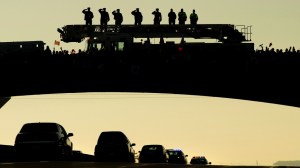
Then on Friday evening, as I was heading home, I stopped to watch Cpl. Cirillo’s procession pass through Burlington.  Brant Street had been blocked off to a single lane, with a firetruck and police cars providing a gentle barricade between pedestrians and vehicles on the overpass.  The sun had nearly set, and hundreds of people were gathered, faintly waving flags and scanning the oncoming highway through the darkening skies and the end-of-rush-hour traffic.  Soon, flashing lights crested the dusk of the 407’s hill; a police motorcycle, and then a handful of police cars silently flashing their red-and-blues, surrounding the hearse.  Silence.  No car horns, no cheers, only a few claps.  Lots of tears, lots of drawn breath, lots of hugs.  The motorcade passed quickly beneath us, on the final leg of its journey to Hamilton.  And we all walked away.  Silence.  

Image Courtesy of www.cp24.com.

Image courtesy of http://www.cp24.com.

When I got home, I saw the pictures of the thousands upon thousands of Canadians who had the same experience I did, lining the Highway of Heroes like a heartbroken Honour Guard.  I’m glad I was there.  I needed to be there.  To represent my family, my gratitude, my emotions.  To mourn, to think, to reflect on what a united country we live in, our True North Strong and Free.  On what a profound impact Cpl. Cirillo has had on Canadians as a whole.  On the grief, the sadness, the dismay, the shock.

From far and wide, O Canada, we stand on guard for thee.

Image courtesy of www.beaconnews.ca.

Image courtesy of http://www.beaconnews.ca.

*** I’ve read a lot about how Corporal Cirillo’s death has received more press than Warrant Officer Vincent’s tragic death earlier in the week.  And while that’s true, it’s not a contest, and it doesn’t minimize Vincent’s service or his sacrifice. He died as a solider, because he was a soldier, in spite of being a soldier. RIP to both, and to all the soldiers we’ve lost before them. ***


Concussion in Sport

I recently attended a conference on concussion management and I learned a lot.  No, make that a LOT lot.  Concussion research has progressed dramatically since I graduated eight years ago, and there’s a void in proper concussion management amongst the sports medicine community.  The conference I attended is hoping to change that.

ccm-logo-v2

Let me change your thinking for a minute.  You’ve likely been told that a concussion is a coup/contracoup injury, meaning the brain bounces against the front of the skull, then the back of the skull, creating an injury.  Research shows that is not the case.  In fact, a concussion is actually a stretch/sheer injury of the brain’s white matter (the neuron’s axons), causing biochemical changes within the brain cell.  That’s why most concussions show no brain damage on CT or MRI.  Concussions are a temporary, recoverable injury.  Hmmmm…..

Here’s the thing with concussions.  They’re under-reported because players do not want to be taken out of the game.

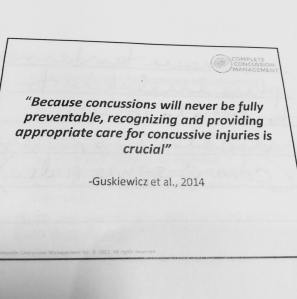
Here’s the other thing:  the brain’s most vulnerable period is in the time period immediately following a concussion, so not pulling a player from the game and subsequently providing a thorough return-to-play protocol is dangerous.   In fact, the research suggests that there is no cumulative effect of concussions, so long as the player has completely recovered from the initial concussion (Eckner et al., 2011).

So how do we safely manage concussion in sport?  

Well, pre-injury baseline testing can certainly help.  Since symptoms alone are a poor indicator of an athlete’s concussion healing, baseline testing allows us to measure many things (balance, reaction time, cognitive ability, memory, visual processing, capacity, etc) and compare the results post-concussion to a pre-injury ‘normal’ state.

Imagine this common scenario:  a 13-year old gets concussed in a hockey game.  Seven days later, they are feeling good and feel ready to return to the ice.  The child is adamant- no headaches, no dizziness, no concentration problems.  So how do we know they’re safe to return?  Well, let’s see how their balance compares to their ‘normal’…. their reaction time…. their memory.  Let’s make sure that we test several areas of brain function to be sure we’ve passed that dangerous vulnerable period (Lazzarino et al., 2012).  Let’s be as sure as the latest research allows us to be.

Screen Shot 2014-10-20 at 1.49.03 PM

In fact, it’s my hope that standardized baseline testing becomes mandatory for all children in all sport.  It’s time.

1555462_610051039107167_7202556248836734029_n


Burlington Sports & Spine Clinic is a part of the Complete Concussion Management network of clinics across Canada.
Give us a call to schedule your organization for baseline testing.