A Place Called Vertigo

There seems to be a vertigo epidemic in my practice as of late.  I’ve had three people in the past month walk through our doors, looking for some relief from their symptoms of vertigo; far and above the four to five cases I typically treat annually.

Vertigo is defined as:

“the sensation of spinning while stationary.”

A specific type of dizziness, vertigo can be unrelenting and difficult to live with, as its sufferers will attest.  But it’s actually quite a common condition, and up to 10% of the population will experience vertigo at some point in their lives.

Can I help?

In short, YES.

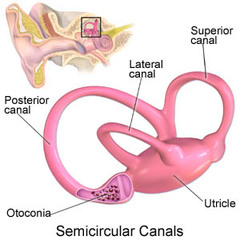
A simple procedure, called the Epley maneuver, is very effective for vertigo when an inner ear component is involved.  You see, our inner ear contains the semi-circular canal, which is a key element in our system of balance.  Tiny calcium carbonate crystals are present within our semicircular canal, and their location allows our body to figure out our head position in space.  If the crystals, called otoconia, are disturbed and get into the wrong spot, our equilibrium gets thrown off, and the end result can be vertigo.
 

lzlkk0xbrh0nnp7y1elzoa_m


The Epley maneuver is painless, takes less than five minutes, and is very effective.  And while I don’t have a double-blind controlled research trial to present to you, I would estimate my success rate with this maneuver to be well upwards of 90%.

Oh, the things you learn on a Tuesday…..


NEW CLINIC HOURS

The week that I’ve been dreading for months has come and gone, and both of my children are now in school full-time, officially closing the a-child-at-home chapter of my life.

My son was born in January 2009, when I was only a few years into my chiropractic career.  My clinic was a brand new baby too, and it soon became apparent that I could not manage being a full-time mom and a full-time business woman effectively.  I chose to sell my clinic and build my practice as a part-time associate rather than a full-time chiropractor, and that’s what I’ve done for the last seven and a half years.  My husband and I have managed to juggle our work hours so that one of us is always at home, thus eliminating the need for daycare, and I’ve gradually increased my clinic hours as my children have gotten older.  The flexibility of my job has been an unexpected quality-of-life bonus for me, and not something that was on my radar as a 20-something embarking upon my chiropractic degree.

Here I am on the other side of that transition away from work.  Taking a conscious step back from my practice in 2009 seemed like a huge undertaking at the time.  The feminist in me felt guilty about taking my foot off the gas of my growing career and the mother in me felt guilty for feeling that way.  But long hours at the clinic were soon traded for long hours of newborns, diapers, and strollers, and my primary hat shifted from clinic to kids.  It’s been that way for a long time, and my “normal” is daytime with my kid(s) and afternoon/evenings with my patients.  That’s about to change.

Effective yesterday, I’ve increased my clinic hours by nearly 50%.  This is the largest change in my professional life to date, second only to the sale of my clinic in 2010.  My daytime availability is skyrocketing, and my afternoon/evening availabity will shift only slightly.  For my current patients, I hope that this opens up more opportunity for you to get an appointment with me at your convenience, and for my new patients, I look forward to having much more time to meet you and help you.

0K0A4007-ExposureIf you’re reading this, you’ve been a part of my professional journey thus far, and I hope that you continue to do so.  I appreciate your support, and I will see you soon.

NEW CLINIC HOURS:

Monday: 11:00am-7:00pm

Tuesday: 9:00am-2:00pm

Wednesday: 9:00am-5:00pm

Friday: 9:00am-6:30pm

Saturday: 9:45am-1:00pm

BSAS Logo-2


“Today is a bad day for backs.”

“Just so you know, today is a bad day for backs.”

That was the text that one of our reception team sent to me last Friday morning.  Three new patients had called in that morning, a much higher number than most Fridays through the Summer months, and all three had a primary complaint of back pain.

BSAS LogoThat part is not atypical; back pain is far and above the most common condition that I treat in my practice, despite us being a full-body, sports-based clinic.  The stats don’t lie, and in fact, up to 85% of working people can expect to experience lower back pain in their lifetime.  Couple that with the word “spine” in our clinic name, and it makes sense that a lot of low back pain walks into our office.

And guess what?  We are really good at treating low back pain.  Really good.  We can make a big difference in a short period of time, and while I don’t have a randomized controlled trial on my patient’s improvement levels to present to you, I can say that our success rate is very high.  We are good at what we do, and a large part of what we do is treat low back pain.

I will go a step further and tell you that what patients do outside of my office (things like following rehabilitation exercises and modifying activities appropriately) are far more important than what they do inside my office, on my treatment table.  The hands-on, manual therapy part is a small piece of the puzzle in a lower back complaint.  My most effective roles become those of educator (why does my back hurt?), ergonomist (what positions should I modify/avoid?), and personal trainer (what movements should I do to feel better?).  My ultimate goal with a lower back pain patient is to avoid a reoccurrent episode down the road; the cycle of lower back pain is all too common.  Again, education, ergonomics, and personal training come into play.

The point?  Lower back pain is very common, NOT normal, and very treatable.  spine-vector-563412

Happy Tuesday all.
