“Today is a bad day for backs.”

“Just so you know, today is a bad day for backs.”

That was the text that one of our reception team sent to me last Friday morning.  Three new patients had called in that morning, a much higher number than most Fridays through the Summer months, and all three had a primary complaint of back pain.

BSAS LogoThat part is not atypical; back pain is far and above the most common condition that I treat in my practice, despite us being a full-body, sports-based clinic.  The stats don’t lie, and in fact, up to 85% of working people can expect to experience lower back pain in their lifetime.  Couple that with the word “spine” in our clinic name, and it makes sense that a lot of low back pain walks into our office.

And guess what?  We are really good at treating low back pain.  Really good.  We can make a big difference in a short period of time, and while I don’t have a randomized controlled trial on my patient’s improvement levels to present to you, I can say that our success rate is very high.  We are good at what we do, and a large part of what we do is treat low back pain.

I will go a step further and tell you that what patients do outside of my office (things like following rehabilitation exercises and modifying activities appropriately) are far more important than what they do inside my office, on my treatment table.  The hands-on, manual therapy part is a small piece of the puzzle in a lower back complaint.  My most effective roles become those of educator (why does my back hurt?), ergonomist (what positions should I modify/avoid?), and personal trainer (what movements should I do to feel better?).  My ultimate goal with a lower back pain patient is to avoid a reoccurrent episode down the road; the cycle of lower back pain is all too common.  Again, education, ergonomics, and personal training come into play.

The point?  Lower back pain is very common, NOT normal, and very treatable.  spine-vector-563412

Happy Tuesday all.


A word is a word is a word…

Last week I received two of the loveliest emails.  Heartwarming, kind words, written by patients who took time out of their day and sent them to me.  They made me smile and gave me reassurance that my goals with my practice are on track; my intentions have always been sincerity, integrity, and comprehensive care.  I want patients to feel like they know “me” (hence this blog) and that they can trust me completely with their musculoskeletal healthcare.  I’m an open book with my emotions, and that extends into my practice life as well- what you see is what you get, and I’m invested in and fully committed to my work and my patients.  I’ve asked both of the aforementioned patients if I can share their words, and they’ve both agreed:

MG wrote:

“Thank you so much for being awesome at what you do!  I feel so much better now that he is under your care.  I’m sincere in all my thanks, I just think you are the best and have the best interests of your patients always in mind. We are on track!”

MB wrote:

“I can’t tell you how much better my Achilles feels today! It is like night and day. Amazing! Thank you very much!!”

Simple words that made a real difference in my life.  And the fact that I’ve made a difference in their lives too means I’m doing my job.  Connecting with people, the people part, is what I love the most.

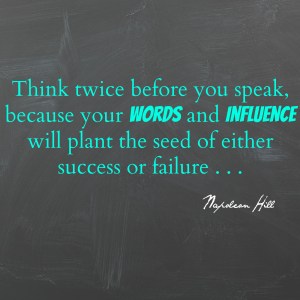
These emails and the positive effect they had on me got me thinking about the power of a compliment and therefore the power of words in general, to help or harm.  As a healthcare professional, I am very careful with my wording and phrasing to patients.  As a mother, I am very careful with my wording and phrasing to my children.  But over the years, like we all have, I’ve missed opportunities to compliment people when in fact I’ve thought the words in my head.

Today, I challenge you to hand out a sincere compliment to three different people in your life via phone, text, or email.  Watch what it does to them, and to you.

words


Straw. Camel’s back.

In my practice, I often ask the question, “Was there an incident that started your pain?  Or did it just creep up on you?”  The answer is very often, “Well, it could be (insert activity here), but I’ve been doing that for years, so I don’t think that’s it.”  But, perhaps, that’s exactly it.

Tissues have a certain amount of force they can withstand before they become injured/dysfunctional/irritated.  This is called tissue tolerance.  The end result of too much force is usually pain.  You see, pain is often the last symptom to appear, not the first.  So, prior to your experience of pain, damage has been done behind-the-scenes for awhile.  If you are body-aware, you may have already noticed this in yourself; perhaps your first perception of a symptom was tightness or decreased strength or lack of range of motion.  But the pain didn’t follow until later.

This process gives us some valuable insights into treatment.  At least, that’s how I see it, and that’s how I treat it.

First, pre-pain symptoms (the above-mentioned tightness, strength, and range of motion) should be watched for and can be used as warning signs to prevent further injury.  Maybe these pre-injury symptoms can be used as healthy reminders to improve your mobility, add in some recovery time, or focus on your nutrition.  Maybe they cause you to re-check your workplace ergonomics or your sleeping positions or your form in the gym.  Maybe they are a signal that your body needs some hands-on treatment.  Listen to those signals, and heed their warnings.

It is much easier to prevent an injury than it is to fix an injury.

Second, just because the pain has disappeared, doesn’t mean that the affected tissues are back to their normal pre-injury state.  This helps to guide my decisions for a patient’s return to activity and give appropriate movement guidelines.  So when I tell you to stop box jumps for the time being, or to raise your computer screen, there’s a method to my madness and science in my reasoning.

The bottom line is this: if you’ve been dead-lifting with a rounded spine for months, or you’ve been sitting at a desk job for years, or you’ve been hunched on your couch with your iPad and “it’s never bothered you before,” doesn’t mean that it won’t bother you now.

Straw.  Camel’s back.  Remember?

straw-camel