Dear Toronto Maple Leafs

March 10th, 2015

Dear Toronto Maple Leafs,

This is not a letter from a fan.  In fact, if I’m being honest, I always cheer against the Leafs.  But the thing is, now I’m raising two little Leaf fans and I adore my Leaf-loving husband.  The Leafs have entered my life, and they’re here to stay, or so it seems.  And so I put pen to paper, or cursor to screen, and here we are.

I am a Canadian-girl and a hockey fan through and through.  I was raised inside cold rural Alberta arenas with french fries, penny candy, and hot chocolate in styrofoam cups.  I saw Gretzky and the 80’s Oilers when I was too young to know what that meant.  As a nine-year-old, I remember watching Fleury’s Stanley Cup winner in my cousin’s basement.  My family had season tickets for the Red Deer Rebels (yes, Phaneuf’s old stomping grounds) and we saw Hockey Night in Canada (or Hockey Night in Toronto?) every Saturday.  I still have Rubbermaid bins full of alphabetical hockey cards from my childhood.  Get it?  I love this stuff.  Okay, has my credibility been established?

So I’m writing to you as a hockey fan, as a mother of Leaf fans, as someone living in the middle of Leaf Nation.  Something needs to change.

The Buds have grown on me through my twelve years as an Ontario resident.  I even cheered from my couch and sported Leaf blue during their 2013 playoff run.  This is not something that most Western Canadians would admit to.  But it’s become increasingly obvious to me that the Toronto Maple Leafs will never be a winning team, and even as an ‘outsider,’ that gets frustrating.

So, here’s what you do:

  • You slash ticket prices.  I mean slash.  Forbes magazine lists the average price of a Toronto Maple Leaf ticket to be $446; far and away the highest in the NHL.  Yes, your bottom line will suffer, but you’re the richest franchise in the NHL, so you can afford a one-year experiment.  Stay with me.
  • You halt corporate sales.  Let’s fill up the ACC with people who’ve paid for their seats and show up for the start of the game.
  • You stop the media circus.  Need I say more?
  • You end up with a building of hockey fans who will cheer loudly and support their team from the stands instead of from their couches at home.  People who start the wave and bring homemade posters and spill popcorn when they jump up to cheer for a goal.  You bring passion.

And the players will play.  And the players will want to play for a franchise as steeped in tradition and as full of history as the anointed Maple Leafs.

Guess what I did when I first moved to Toronto, at 22 years old, all alone and not knowing anyone?  I took the subway down to Carleton and Church and walked beside the old Maple Leaf Gardens.  It gave me goosebumps.  I want my kids to have those goosebumps when they reminisce about their Canadian childhood hockey experience, rather than frustration over another missed playoff run or a team that didn’t try.

Let’s give it a year.  If it doesn’t work, you can always go back to ‘rebuilding.’

Thanks,

Ashley Worobec

IMG_0256

My husband and kids supporting their team.


One click. One vote. One torch.

I usually publish my blog posts on Tuesdays. But, you see, this is not a usual week.

I was just notified that I’m one of twelve finalists nominated to carry the Pan Am torch as it makes its run through Burlington this Summer, en route to Toronto for the 2015 Pan Am Games.  I can’t think of a cooler opportunity.  My friend and neighbour, Marnie, sent in a nomination unbeknownst to me, and here I am, excited about the impossible becoming possible.

Pan Am news is everywhere in the GTA.  Commercials abound, billboards are popping up, and the buzz is growing.  This is kind of a big deal.  Toronto 2015 is only the third time in 85 years that these International Games have been held on Canadian soil.  Right in our own backyard.

And it’s exactly the type of thing I love.  I’ve been to the World Track & Field Championships, three World Junior Hockey Championships, and a College Bowl game.  I’ve cheered at more NHL, CFL, MLB, NBA, NLL, and MLS games than I can count.  I plan family outings around sporting events, I time my holidays around races, and I nearly knocked over Mike Weir on the fairway of a PGA event (true story).  I am a sports-based chiropractor, I married a Phys Ed teacher, and my kids know that fitness is a part of life.  I believe that grassroots minor sports are windows of opportunity, growth, and dreams. I live and breathe this stuff, it’s what makes me tick, it’s what makes me me.  Passion?  Nope.  It’s more than that.

Sport is community.  Sport is health.  Sport is important life lessons all rolled up and condensed onto a playing field.

I’m a fan.  I’m an athlete.  I’m a mom raising fans and athletes.

So I am turning to you, my community.  I am hoping for your support, asking for your help, tugging at your heart strings, requesting your vote.  One click.  One vote.  One torch.

Please VOTE here: http://cms.burlington.ca/Page14733.aspx#.VJN5nrgYU

With my humble thanks,

Ashley

Torch Relay Celebration Community


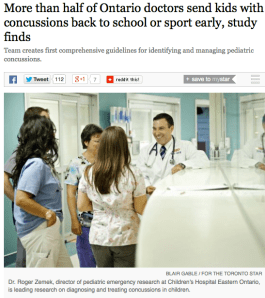
Concussion in Sport

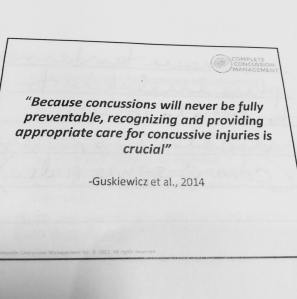
I recently attended a conference on concussion management and I learned a lot.  No, make that a LOT lot.  Concussion research has progressed dramatically since I graduated eight years ago, and there’s a void in proper concussion management amongst the sports medicine community.  The conference I attended is hoping to change that.

ccm-logo-v2

Let me change your thinking for a minute.  You’ve likely been told that a concussion is a coup/contracoup injury, meaning the brain bounces against the front of the skull, then the back of the skull, creating an injury.  Research shows that is not the case.  In fact, a concussion is actually a stretch/sheer injury of the brain’s white matter (the neuron’s axons), causing biochemical changes within the brain cell.  That’s why most concussions show no brain damage on CT or MRI.  Concussions are a temporary, recoverable injury.  Hmmmm…..

Here’s the thing with concussions.  They’re under-reported because players do not want to be taken out of the game.

Here’s the other thing:  the brain’s most vulnerable period is in the time period immediately following a concussion, so not pulling a player from the game and subsequently providing a thorough return-to-play protocol is dangerous.   In fact, the research suggests that there is no cumulative effect of concussions, so long as the player has completely recovered from the initial concussion (Eckner et al., 2011).

So how do we safely manage concussion in sport?  

Well, pre-injury baseline testing can certainly help.  Since symptoms alone are a poor indicator of an athlete’s concussion healing, baseline testing allows us to measure many things (balance, reaction time, cognitive ability, memory, visual processing, capacity, etc) and compare the results post-concussion to a pre-injury ‘normal’ state.

Imagine this common scenario:  a 13-year old gets concussed in a hockey game.  Seven days later, they are feeling good and feel ready to return to the ice.  The child is adamant- no headaches, no dizziness, no concentration problems.  So how do we know they’re safe to return?  Well, let’s see how their balance compares to their ‘normal’…. their reaction time…. their memory.  Let’s make sure that we test several areas of brain function to be sure we’ve passed that dangerous vulnerable period (Lazzarino et al., 2012).  Let’s be as sure as the latest research allows us to be.

Screen Shot 2014-10-20 at 1.49.03 PM

In fact, it’s my hope that standardized baseline testing becomes mandatory for all children in all sport.  It’s time.

1555462_610051039107167_7202556248836734029_n


Burlington Sports & Spine Clinic is a part of the Complete Concussion Management network of clinics across Canada.
Give us a call to schedule your organization for baseline testing.