Straw. Camel’s back.

In my practice, I often ask the question, “Was there an incident that started your pain?  Or did it just creep up on you?”  The answer is very often, “Well, it could be (insert activity here), but I’ve been doing that for years, so I don’t think that’s it.”  But, perhaps, that’s exactly it.

Tissues have a certain amount of force they can withstand before they become injured/dysfunctional/irritated.  This is called tissue tolerance.  The end result of too much force is usually pain.  You see, pain is often the last symptom to appear, not the first.  So, prior to your experience of pain, damage has been done behind-the-scenes for awhile.  If you are body-aware, you may have already noticed this in yourself; perhaps your first perception of a symptom was tightness or decreased strength or lack of range of motion.  But the pain didn’t follow until later.

This process gives us some valuable insights into treatment.  At least, that’s how I see it, and that’s how I treat it.

First, pre-pain symptoms (the above-mentioned tightness, strength, and range of motion) should be watched for and can be used as warning signs to prevent further injury.  Maybe these pre-injury symptoms can be used as healthy reminders to improve your mobility, add in some recovery time, or focus on your nutrition.  Maybe they cause you to re-check your workplace ergonomics or your sleeping positions or your form in the gym.  Maybe they are a signal that your body needs some hands-on treatment.  Listen to those signals, and heed their warnings.

It is much easier to prevent an injury than it is to fix an injury.

Second, just because the pain has disappeared, doesn’t mean that the affected tissues are back to their normal pre-injury state.  This helps to guide my decisions for a patient’s return to activity and give appropriate movement guidelines.  So when I tell you to stop box jumps for the time being, or to raise your computer screen, there’s a method to my madness and science in my reasoning.

The bottom line is this: if you’ve been dead-lifting with a rounded spine for months, or you’ve been sitting at a desk job for years, or you’ve been hunched on your couch with your iPad and “it’s never bothered you before,” doesn’t mean that it won’t bother you now.

Straw.  Camel’s back.  Remember?

straw-camel


“When Should I get Treatment?”

“When should I get treatment?”

I get asked this question a lot, most often by people who are nursing an injury, hoping that I’ll tell them to just wait it out.  And the truth is, for most injuries, waiting it out will ease your symptoms.  Nature will take its course, your body will know what to do, and your pain will subside.  But is that really the best option?

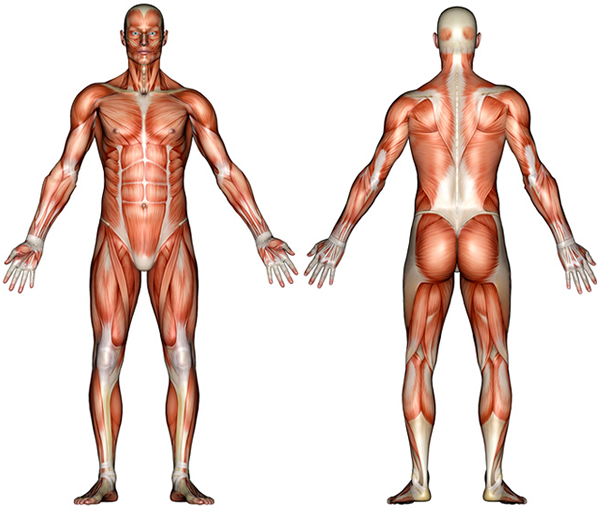
blank-muscle-anatomyYou see, our bodies are very, very smart.  They know what to do to fix things, far better than I claim to know.  But the thing is, our bodies don’t take compensation injuries into account.  A rob-Peter-to-pay-Paul situation often develops.  And let’s not forget the time factor; manual therapy can speed up healing rates.

Take the common example of knee pain.  Your knee hurts.  So you take some time off from the gym, modify your daily activities, and utilize home remedies like stretching and Voltarin and hot tubs and ice.  You feel better, so you return to the gym and the physical rigors of daily life.  But your knee pain starts to creep back in, although milder than before, and now it’s accompanied by lower back pain.  Why?  Well, the cause of your knee pain was never really addressed with all of your stretching and Voltarin-ing and hot tubbing and icing, so when you resume activity, it comes back.  And your body has done such a excellent job of compensating (gait changes, postural changes, biomechanical changes) that your lower back worked extra hard and is now paying the price via a secondary injury.  And you forgot to maintain your core strength while you did all that laying around nursing your knee pain.  Sigh.

“When should I get treatment?”

You should get treatment if home remedies aren’t working effectively.

You should get treatment if you want to get back in the game faster.

You should get treatment if you want to be proactive and preventative with your health.

“When should I get treatment?”

Now.

BSAS Logo-2


“You’re Not Ready Yet”

An athlete who returns to training fearful about re-injury is an athlete that is more prone to re-injury.

Think about that statement for a minute.  Now why would I choose to write about this topic?  Because it’s something that I deal with almost daily in my practice.  If you are reading this as a patient, perhaps you can relate, and if you are reading this as a practitioner that works with athletes, most certainly you can relate.

photo-13

My knee surgery- March/2005

But, you see, this is one of the reasons that I LOVE working with athletes… I love their I-cannot-rest-I-need-to-get-back-to-training attitude.  Because I’m like that too.  I’m one of them.  I’m the basketball player who broke her thumb and finished the tournament (ask my parents).  I’m the ball-hockey player who tore her ACL and kept training for a marathon (ask my friends).  I’m the runner who sprained her ankle, taped it up, and competed anyways (ask my husband).  Were these smart decisions?  Probably not.  Would I choose differently now?  Also probably not.

But….. and this is a big but, a huge however, and an extreme nonetheless…. getting back to training before your injury is healed is not the best choice in the long run.  Let me say that again in a different way: if you injure a structure in your body and that structure is not healed before you resume training, you will re-injure yourself.  And, most likely, it’ll be worse the second time around.

That’s where the fear component comes into play.  Remember my original statement?  An athlete who returns to training fearful about re-injury is an athlete that is more prone to re-injury.  I believe that athletes know their bodies far better than I, their healthcare practitioner, do.  Sure, I know the anatomy, I understand the biomechanics, and I can draw upon research studies and my professional experience, but I don’t really know what they’re feeling.

I’m not referring to their fear of the consequences of re-injury (ie. the baseball player who worries about missing the rest of his season, the Crossfitter who worries about completing the next Open workout, the runner who worries about finishing her next marathon)- those are normal, understandable, expected fears.  I am talking about the fear, the apprehension, the tentativeness, the uneasiness, the doubt that can creep in under the surface of it all and whisper to the athlete “you’re not ready yet.”  That’s where re-injury happens.

To my athletes: if I give you the green light to resume training and fear murmurs “you’re not ready yet,” tell me.  And I will agree.

everyday get better