
“A Healthy Back: for Crossfit and for LIFE”….. this is the presentation I’m doing at Crossfit Altitude on Thursday evening, (February 6th at 7:00pm). It’s going to be a hands-on, active-participation, lots-of-questions-and-answers event and I’ve capped the registration at 20 people so that we can have some great learning opportunities and hopefully some ‘a-ha’ moments.
The reason that I wanted to host this talk is that I’ve seen an increase in the number of lower back injuries in my practice as of late. “But you’re a chiropractor” you say, “don’t you always see lower back injuries?” The answer is yes, but my practice is centred around athletes and active people, so I see a whole host of other injuries as well; from ankle sprains and elbow pain to migraine headaches and knee problems. Unfortunately, back injuries seem to have claimed the top spot for the past few months. So the point of this event is education……. leading to prevention.
What’s the plan, you say?
- We’re going to talk about anatomy. If you don’t understand the components of your lower back, how can you understand how to keep it healthy?
- We’re going to talk about the three most common back injuries that I see in my practice, and how they relate to Crossfit specifically.
- We’re going to move; we’re going to stretch, and strengthen, and talk about tips and suggestions that you can implement into your everyday life.
- We’re going to have lots of time to chat; I want participants to go home with all of their back pain/injury/health questions answered.
One of my very first blog posts, that you can view here, was surrounding the misconception that Crossfit causes injuries. I argue that injuries are simply a part of sport, and that the benefits of an active lifestyle far outweigh the risks. I feel very passionate and definitive about this statement.
This event is currently full, but if the interest is there, I would be happy to host another one. Or to come and talk to your group about injury prevalence and prevention, specific to your situation.
As long as we are using our bodies, we need to take care of them!
See you on Thursday.
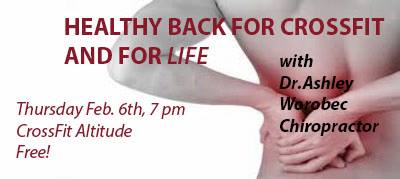
Here’s the associated blurb:
Crossfit does not cause lower back injuries, but poor form and weak mechanics do! Do you want to learn how to PREVENT and FIX common lower back injuries? Do you want to avoid that nagging post-deadlift ache? That chronic prolonged-sitting pain? That constant I’m-sore-until-I-warmup discomfort? Then come and join Dr. Ashley Worobec as she talks about common lower back injuries, how to prevent them, and how to fix them! This will be a hands-on active-participation seminar, so come dressed for movement! You will go home with a new appreciation of your lower back and some tips and tricks to keep it healthy and strong so that you can continue to Crossfit (and live) pain-free.

 drworobec.com