I Don’t Make my Kids Make their Beds

messyhair

I don’t make my kids make their beds.

There, I’ve said it.  It’s like admitting a dirty little secret.  So I’m airing my dirty laundry, and there you have it: I don’t make my kids make their beds.

I grew up being expected to make my bed daily, and I am actually quite a neat-freak, so this fact is a bit out of character for me.  But truth be told, I don’t make my own bed either (unless tossing a duvet across it counts….. and even that only gets done half the time).  The reality is, it’s just not that important to me.  Life is very full and very busy and I am having too much fun going to the park or heading to work or reading with my kids to be worried about unmade beds.

It took me awhile to become comfortable with this fact.  I often get stricken with the ‘I-shoulds’, and being okay with unmade beds seemed to go against what parenting books would advise.  But as life got busier, one child turned into two, and my caring-what-other-people-think declined, I came to peace with my choice.  I do have some stipulations with this decision; I have taught my children how to make their beds, and I will quickly pull up the covers on a disheveled mess before company comes over.  But the reality is, in my day-to-day normalcy, unmade beds are a staple.

And I’m okay with that.

most memorable

This sign hung in my laundry room for many years, and sums up my parenting philosophy quite nicely…


“Please try not to spill it”

“Please try not to spill it.”  These words have come out of my mouth many times over the years, and I’m going to change that immediately.  Here’s why:

  • Because confidence.
  • Because self-worth.
  • Because who has time to care about messes?

How-To-Believe-In-YourselfI have two impressionable little people under my care, and I think my most important job is to make sure that they believe in themselves.  In their self-worth.  In their abilities.  In their importance.

“Please try not to spill it.”

The last time I said this, my newly three-year-old was carrying her plate from the kitchen counter to the table for lunch.  This is a skill she’s just learning- to balance a plate of food while walking.  She’s graduating from toddler to kid, and is starting to help out around the house with the little things she’s able to do.  Expectations for my kids are age-appropriate, but when she sees her six-year-old brother doing things, she wants to be a big kid too.  And I want to foster that.

“Please try not to spill it,” I said, as I passed her the plate.  And I saw her hesitate.  Just a little stutter-step, just a little pause, just a little self-doubt….. that I’d planted with my comment.  My heart broke into a million pieces.  I saw it happen:  right before my eyes her mind shifted from the confident “I’m-a-big-girl,” while “Mommy-doesn’t-think-I-can-do-this” creeped in.

Now perhaps some of you are thinking that’s ridiculous.  We need to parent our children, you say.  We need to guide them, you say.  We need to teach them, you say.  And I believe this to be true.  But please tell me why it would be necessary to say “please try not to spill it?”  As if, by omitting this phrase, you would be encouraging the child to spill?  As if the child would purposefully try to spill and fail?  As if the child cannot make a mistake?  “Please try not to spill it” does not need to be said because the child will already be trying not to spill it.  Done and done.

Am I being too sensitive to this?  Too emotional?  Too picky?  I don’t think so.  I’m a sensitive soul and I know my kids.  “Please try not to spill it” does not promote the iamawesome-b649faed7b69b457b00e75e50158d7db self-confidence that I’m trying to cultivate in them.  It does not add to their world and their worth.  So it doesn’t make the cut.

Back to my earlier example, my daughter did not in fact spill her lunch, and she was very proud of herself for crossing the kitchen successfully.  But if she had spilled, I would hope to use that as an opportunity for both of us to learn and grow.  First, she was using a plastic children’t plate (like it would make a difference if the plate was breakable?  ‘Wear the Dress Socks,’ remember?).  Second, I can control my reaction so that it provides no fear component or worry about my approval.  And third, and most notably, spills teach that people make mistakes.  We clean up and move on.   Life happens.  And it’s often messy.

So I’m going to keep trying to set my children up for success, I’m going to keep trying to help them learn from their mistakes, and I’m going to keep trying to figure out this parenting gig.

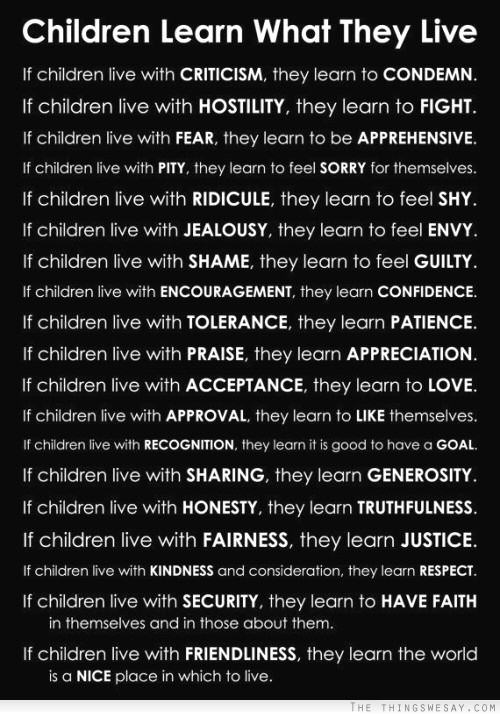
“Children are great imitators, so give them something great to imitate.  ~Unknown.”
7237


Please Don’t Pity Her

My little girl, who is two years old for only two more weeks, is one of the strongest people I know.  She has taught me so much in so little time, and her lessons continue to surprise me.

She’s the kid who faceplants and gets back up with her toddler-speak, “I okay.”  She’s not scared of needles or dark rooms or strangers.  She’s tough.  Please don’t pity her.

If you’ve been following my blog, you’ll know that last Spring she was diagnosed with amblyopia, an eye disorder that causes decreased vision in an eye that otherwise appears normal.  In fact, when we brought her to the optometrist last April, the vision in her left eye was only 20/80.  Did I suspect a vision deficit?  Nope, not at all.  In fact, the only reason I got her eyes checked is because we were already there for her brother’s appointment and we had the time.  So, here’s my PSA: Get your children’s eyes checked annually.  OHIP funds yearly eye exams for people under 20 years of age.

Along with her considerable lens prescription, we also have to patch her strong right eye three hours every day to force the weaker left eye to work harder.  This past October, after only six months of glasses and patching, my determined little firecracker had improved to 20/30 vision.  Her body is responding and she’s progressing just as we’d hoped.  But we will have to continue to use occlusion patching for the foreseeable future; you see, as malleable and flexible as children’s brain and nerve development are, they can also regress.  I’m told we have until age seven to make gains with her vision, since the improvement of her particular deficit ceases after that point.  Early detection is key.  We need to keep our foot on the gas and our eye on the prize for another four or five years.

When we first learned about all of this, I worried about the ‘differences’ it would create for her.  I worried about the looks she’d get and the teasing she’d endure.  And then I remembered who I was dealing with: the kid who sticks up for herself and has a heart of gold.  She’ll be fine.  She is fine.

Her patch is just a part of her childhood, a part of who she is at this point in her toddler life.  We ordered some ‘fun’ patches for her, complete with glitter and animals and bright colours.  Every morning she gets to choose a patch that suits her mood.  Most often, it’s puppies or bunnies or anything sparkly.  Just like her, sparkly.

Don’t feel sorry for her, feel proud of her.  Please don’t pity her.  

03i9d4pr