Concussion in Sport

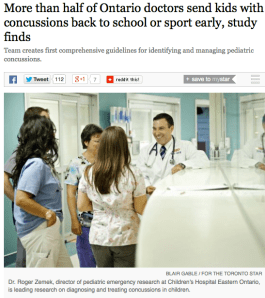
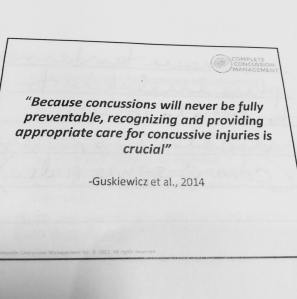
I recently attended a conference on concussion management and I learned a lot.  No, make that a LOT lot.  Concussion research has progressed dramatically since I graduated eight years ago, and there’s a void in proper concussion management amongst the sports medicine community.  The conference I attended is hoping to change that.

ccm-logo-v2

Let me change your thinking for a minute.  You’ve likely been told that a concussion is a coup/contracoup injury, meaning the brain bounces against the front of the skull, then the back of the skull, creating an injury.  Research shows that is not the case.  In fact, a concussion is actually a stretch/sheer injury of the brain’s white matter (the neuron’s axons), causing biochemical changes within the brain cell.  That’s why most concussions show no brain damage on CT or MRI.  Concussions are a temporary, recoverable injury.  Hmmmm…..

Here’s the thing with concussions.  They’re under-reported because players do not want to be taken out of the game.

Here’s the other thing:  the brain’s most vulnerable period is in the time period immediately following a concussion, so not pulling a player from the game and subsequently providing a thorough return-to-play protocol is dangerous.   In fact, the research suggests that there is no cumulative effect of concussions, so long as the player has completely recovered from the initial concussion (Eckner et al., 2011).

So how do we safely manage concussion in sport?  

Well, pre-injury baseline testing can certainly help.  Since symptoms alone are a poor indicator of an athlete’s concussion healing, baseline testing allows us to measure many things (balance, reaction time, cognitive ability, memory, visual processing, capacity, etc) and compare the results post-concussion to a pre-injury ‘normal’ state.

Imagine this common scenario:  a 13-year old gets concussed in a hockey game.  Seven days later, they are feeling good and feel ready to return to the ice.  The child is adamant- no headaches, no dizziness, no concentration problems.  So how do we know they’re safe to return?  Well, let’s see how their balance compares to their ‘normal’…. their reaction time…. their memory.  Let’s make sure that we test several areas of brain function to be sure we’ve passed that dangerous vulnerable period (Lazzarino et al., 2012).  Let’s be as sure as the latest research allows us to be.
Screen Shot 2014-10-20 at 1.49.03 PM

In fact, it’s my hope that standardized baseline testing becomes mandatory for all children in all sport.  It’s time.
1555462_610051039107167_7202556248836734029_n


Burlington Sports & Spine Clinic is a part of the Complete Concussion Management network of clinics across Canada.
Give us a call to schedule your organization for baseline testing.


What-Shall-We-Do-Today Mornings

PLEASE NOTE:
I will be expanding my practice to
include MORNING appointments on Tuesdays and Thursdays,
effective Thursday, September 18th.


BSAS Logo-2

For more than five and a half years, I haven’t had to rush out of the house, amidst the madness of a morning routine.  You see, I’ve been very lucky to be able to manipulate my work schedule around the needs of family life.  And with young children, those needs have involved me at home every morning.

I don’t want you to get the impression that my mornings are wide open, because they most definitely are not.  We always spend mornings out of the house and on-the-go, going about the daily ritual of teaching, building, and growing little minds and little bodies.  We’ve done dozens upon dozens of registered programs over the years, and hundreds of playdates, playgrounds, and trips to the library.  We’ve done Nursery School, swimming, skating, and story-times.  We’ve done Early Years drop-ins, indoor playgrounds, and trips to the mall.  We’ve done more day trips than I can count and more overnights than the norm, but we’ve never had a daily early morning deadline.  No rushing kids through breakfast, no frantic searches for shoes and water bottles, no we-need-to-leave-five-minutes-agos.  Until now.

Gone are the days of the pyjama-lounging, coffee-drinking, what-shall-we-do-today mornings.  For nearly six years, this has been our luxury.  But that all changes this week, as my son begins full-day Senior Kindergarten and my daughter starts Nursery School twice a week.  Morning routines will begin.  Clock-watching will start.  I may even have to (gasp!) wake my children up.

I’m sure we will manage.  I’m sure we will find our ‘new normal’.  I’m sure we will scramble through September, only to find that October comes quickly.  And soon, very soon after that, I will look back at September 2nd and not be so scared.

back-to-school-4


“Do you Adjust Children?”

***This was originally written as a Guest Blog post for Momstown.ca.***

I got asked this question at the gym the other day.  Someone I barely knew, stopped me mid-warmup to ask, “you’re a chiropractor, right?  Do you adjust children?”  And I guess that’s a fair question.  But my “yes I am and yes I do” response was met with a skeptical “wow, I can’t believe that people do that.”  Hmmmm, now how to respond?

I guess I could’ve said that chiropractors are neuro-musculoskeletal (NMSK) specialists; NMSK means nerves, muscles, and joints.  That we’re primary healthcare providers.  That we can diagnose.  That we’ve got 7+ years of post-secondary education.  But that’s too “wordy” for casual conversation.

I could’ve said that I have two young children and regularly check their spines and adjust them as necessary.  Or that they both received their first adjustments within hours of their births.  Or that my son’s neck was so restricted that he would only nurse on one side pre-adjustment.  Or that a lower back/pelvic adjustment is the best laxative I’ve found for them.  Or that my kids “play chiropractor.”  Nah, too “mommy.”

I could’ve said that the birth process is pretty intense and can be traumatic on tiny spines.  I could’ve said that I’ve seen incredible results with colic, constipation, and congenital torticollis in my practice.  I could’ve said that children respond remarkably well and exceptionally fast to treatment.  I could’ve said that we get our children’s teeth, eyes, and ears checked, so why not their spines too?  No, too “clinical”.

I could’ve said that I’ve taken extensive post-graduate studies in pediatric care.  Or that the research supports chiropractic treatment in the pediatric population.  Or that I am thoroughly confident in the safety of everything I do and I must “first, do no harm”.  Nope, too “academic”.

Instead, I said “yes, people do that.  We all do what we think is best for our children.”  Then I finished my workout….. and went home to adjust my kids.

ahh