A word is a word is a word…

Last week I received two of the loveliest emails.  Heartwarming, kind words, written by patients who took time out of their day and sent them to me.  They made me smile and gave me reassurance that my goals with my practice are on track; my intentions have always been sincerity, integrity, and comprehensive care.  I want patients to feel like they know “me” (hence this blog) and that they can trust me completely with their musculoskeletal healthcare.  I’m an open book with my emotions, and that extends into my practice life as well- what you see is what you get, and I’m invested in and fully committed to my work and my patients.  I’ve asked both of the aforementioned patients if I can share their words, and they’ve both agreed:

MG wrote:

“Thank you so much for being awesome at what you do!  I feel so much better now that he is under your care.  I’m sincere in all my thanks, I just think you are the best and have the best interests of your patients always in mind. We are on track!”

MB wrote:

“I can’t tell you how much better my Achilles feels today! It is like night and day. Amazing! Thank you very much!!”

Simple words that made a real difference in my life.  And the fact that I’ve made a difference in their lives too means I’m doing my job.  Connecting with people, the people part, is what I love the most.

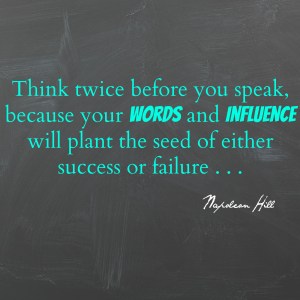
These emails and the positive effect they had on me got me thinking about the power of a compliment and therefore the power of words in general, to help or harm.  As a healthcare professional, I am very careful with my wording and phrasing to patients.  As a mother, I am very careful with my wording and phrasing to my children.  But over the years, like we all have, I’ve missed opportunities to compliment people when in fact I’ve thought the words in my head.

Today, I challenge you to hand out a sincere compliment to three different people in your life via phone, text, or email.  Watch what it does to them, and to you.
words


Integrity.

We went for a hike yesterday, on Victoria Day.  It was a gorgeous holiday Monday, and the first solid taste of Spring warmth that we’ve had, with April and May being cold and wet thus far.  We went with great friends of ours, so we had three kids with us, all in the four to seven age range.  And as with most situations as a parent, some teachable moments presented themselves.

The conservation area that we went to was very busy, full of crowds of people, dogs, and picnic baskets.  We hiked along the trail, admiring the views, and listening to the chatter of our children as they ran back and forth, finding walking sticks and leaves, weeds and wildflowers.  We searched for chipmunks, talked about the plants lining the path, and stopped for a picnic lunch under the shade of a tree.  The ultimate destination of our hike was a waterfall, which made for great motivation to keep little legs moving forward and not lagging behind.

The trail led us towards a lookout platform, whereby we could see dozens of people at the base of the waterfall, sticking their feet in the cool water of the stream and admiring the force of the water as it cascaded down.  “Let’s see if we can get down there,” we agreed.  The kids were anxious to explore, and when I had read about this spot online, people talked about the ability to get up close and walk behind the falls.  It was something I’d mentioned to our children in the car on the way there, and that adventure was a big reason that they were so excited.

We continued along the path toward where we thought the access point to the base would be; but when we got there, we found that a black metal fence surrounded the entire area, and the stairs that led to the base of the gorge were roped off.  “No fence jumping” yellow signage was everywhere, and “Danger: stairs are unsafe” was clearly marked behind the double-barricade at the staircase entrance.

“We can’t go down there after all,” we told the kids.  “It’s not safe, and look at the signs.”  Yet as we explained the whys and why-nots to our disappointed crew, we watched dozens upon dozens of people jump the fence and go around the barricades.  The pathway that they walked, along the outside of the “no fence jumping” fence, was no wider than two feet across in some areas and traced the edge of the gorge’s 79-foot dropoff.  My heart raced as I saw women in wobbly high heels and preschoolers holding their parent’s hands trek precariously along this narrow route and down the “Danger: unsafe stairs” to the waterfall’s base.   There was a steady stream of people doing this, and we were the clear minority by choosing not to.

To their credit, the kids took this turn of events well.  They were mostly content to watch from the lookout, to have a snack by the bridge, and to climb trees.  But my seven-year-old did press the issue, and I found myself in a “I need to handle this well” parenting moment.  He’s an adventurous, curious boy who loves nature and exploring, and to miss the chance to go behind a waterfall when hundreds of others were doing it right in front of him was a hard lesson to learn.

In hindsight, I’m sure he and I could’ve made the trek down safely, and I bet some of you are questioning why I didn’t let him have that chance.

It’s because I don’t think that was the right lesson to teach.
635723546458745098-1499222611_3849122f5f642b50654d34b0c0712396


A Happy Life

I’m still trying to figure out the nuances of me.  I know that sounds strange.

But in fact, just the other day, I discovered that I can focus much better in complete silence.  It’s not that I didn’t already know this about myself; after all, I spent eight years of post-Secondary education in quiet libraries, but I’ve just recently learned to articulate this fact.  No wonder my study days in Mt. Pleasant’s Second Cup required earplugs.  How unusual that I never noticed this quiet=focus effect on myself.

I’m emotional.  I’m sensitive.  I see colours when I read words, especially people’s names.  I am a homebody.  I love to travel, often, but for short periods of time.  I have a semi-photographic memory, especially for the written word.  I am interested in real estate and architecture.  I have a spatial mind.  I communicate best through writing.  I only like camping if someone else is doing the work.  I love yoga and spirituality and self-reflection.  I need fresh air and an elevated heart rate daily.

These are all revelations that I’ve had in my adult life.  I’m 36 years old and I’m still figuring out me.  And the reason I’m telling you this?

  1. My blog is an extension of my professional self.  The doctor-patient relationship is built on trust and this outlet is how you can get to know me. (This is Me.)
  2. These revelations have affected my parenting, and hey, I like to write about parenting.

How has it affected my parenting, you ask?  Well, thank you for asking, you’re playing along nicely.  You see, as a teen I often overheard people talk about “figuring out who they are” and I didn’t quite understand what that meant.  I heard people talk about “figuring out who they are” at University, “figuring out who they are” through travel, “figuring out who they are” through sport.  I did all of those things, and yet I still couldn’t define myself, my role, my reason.  These revelations seem to have come to me later in life than most of my peers, or perhaps I’m just late in learning the vocabulary associated with soul-searching and self-contemplation.

As such, lately I’ve been talking to my children about “who they are.”  We’ve been chatting about things they like, things they don’t, things that are/aren’t important to them, and their hopes and dreams.  I’ve been trying to give them the verbiage of introspection, to open up their childhood minds to the language of what characterizes them, and makes them proud to be unique and special.  To be themselves, whomever those selves may be.

For now, my job is to give them opportunities to learn.  I see each exposure to something new as a chance for personal growth.  That’s why we spend our Summers traipsing around Southern Ontario and our Winters at every event within an hour’s drive.  We go to see monster trucks and rodeos and conservation areas and waterfalls and baseball games and theatres and ceramic studios and Teen Tour Band concerts and beaches and outdoor rinks.  We show them the world and try to help them figure out their role in this wonderful community of life.

I posted this on my Facebook Page a few days ago: “I really think a happy life is about balancing all of your favourite things.  Lower the stressors you have control over and prioritize the things that you love.”  And how are they to know the things that they love if I don’t give them the tools to discover that?

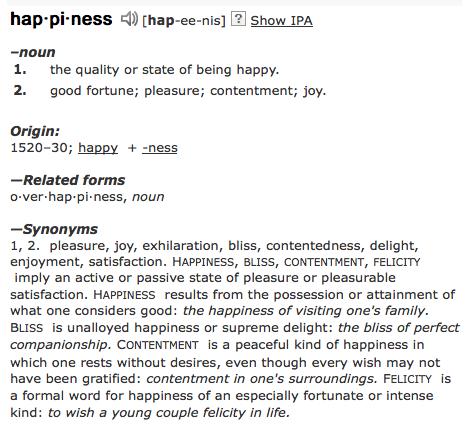
“Happiness results from the possession or attainment of what one considers good.”

And it seems to me that if you figure out your good, you will figure out your happy.


happiness