“and your back pain is going to go away”

“You know what really helped me?” a patient recently said during her second treatment with me.  “The fact that you told me that my back wasn’t going to go out.

I hear this type of thing often.  This particular patient was suffering with lower back pain, and had a previous history of an exceptionally debilitating episode that made her temporarily unable to care for her two young children.  Her fear level was high.  On her first visit to the clinic, I spent much of our time together talking with her, explaining what was happening to her back, and why she was having pain.  Patient education is patient empowerment.  I did some hands-on manual therapy and then we chatted about rehabilitation exercises and the importance of movement, something that people in pain tend to avoid.  The last words I said to her before she left were along the lines of “don’t worry, you’re going to be fine, and your back pain is going to go away.”  A huge part of my job is patient education, because knowledge is power.

And just so that we’re all on the same page moving forward, backs don’t “go out” and then “go back in,” running does not cause arthritis in your knees, and getting adjusted three times a week for the rest of your life will not prevent stage three spinal degeneration.  Yet these are all proclamations that patients come in and tell me about themselves; these blanket statements are untrue and damaging, and in most cases, patients have been told these things by a health professional.  As chiropractors, and certainly as all healthcare providers, we cannot underestimate the power of our words for the good and for the bad.  If you have a patient’s trust and respect, you have the power to remarkably alter the course of their healing and the perception of their body’s abilities through your words alone.

This is the same reason that medical imaging can often be detrimental; because it affects a patient’s psyche.  Did you know that in many cases, there is actually a very poor correlation between what is shown on a medical image (an X-ray, for example) and a patient’s symptomatology?  But if a patient is shown an x-ray of “degenerative joint disease” (that’s a fancy term for arthritis) in their spine, they will come to believe that they have an arthritic, incapable, dysfunctional body.  This person then tends to become fearful of movement and therefore moves less.  And what creates a perfect storm for unhealthy joints?  Lack of movement.  Herein lies the problem.

Healthcare professionals: please do be careful with your words, and patients: please do be careful of what you listen to.

sticker375x360-u3


I Am a Chiropractor. Take two.

1c25cea660395e6dd7a183c6208c9a2f I’ve been a chiropractor for nearly ten years.  Ten years….. how did that happen so quickly?  And as my practice has grown, I’ve been confronted with more and more misconceptions surrounding what it is that I actually do.  These are some questions I’ve been asked in just the last couple of weeks (and if you click on the links, you’ll see I’ve written about all of them):
  • Do I treat children?  Yes.
  • Do I treat muscular injuries? Yes.
  • Can I manage concussions and return-to-play protocols?  Yes.
  • Do I think rehabilitation exercise is important for back pain?  Yes.
  • Am I still accepting new patients?  Yes

In light of all this, I wanted to share with you a post that I wrote a couple of years ago when my blog was shiny and brand-new.  This is my most-read post of all time.  I hope that you enjoy it the second time around, and that it gives you a glimpse into the way that I work:

~~~

I am a chiropractor.  But my definition of what a chiropractor is might be different than yours.  Is that because of the broad range of chiropractors out there?  Is that because of the assumptions and misnomers surrounding chiropractic?  Is that because of the way that I practice chiropractic?

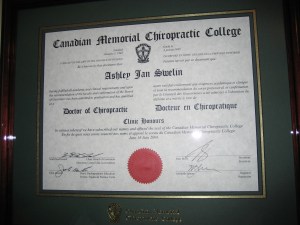
Maybe it’s all of the above… My first involvement with the chiropractic profession began when I was 21.  Fresh off a Bachelor of Science from the University of Calgary, I still didn’t know what I wanted to ‘be when I grew up’.  A friend of mine was a chiropractor and needed someone to work at the front desk of his clinic and I needed a job while I figured out my next step in life.  Enter Fate, stage left.  My path in life was suddenly clear.  I would become a chiropractor.  I sent off my application immediately, and began my four years at CMCC (Canadian Memorial Chiropractic College) that Fall.

I am a chiropractor.  

This is what I do: I do treat pain related to the spine, pelvis, nervous system, and joints of the body.  I do not only treat back pain and neck pain.

I use rehabilitation exercises, Active Release, acupuncture, Graston, and adjustments.  I am a chiropractor who rolls around on the ground to demonstrate exercises.  I am a chiropractor who watches you run if it hurts when you run, and who watches you throw if it hurts when you throw.

I do believe that the adjustment is a powerful tool, but it’s one of many and it’s not always appropriate.  I do not only use adjustments when treating an injury.

I am a chiropractor who believes that less-invasive is better than more-invasive.  I am a chiropractor who pays attention to research.  I am a chiropractor who pays attention to my patients.  I am evidence-based.  I am holistic.

I do enjoy working with those who want to heal quickly and are willing to be an active participant in their care.  I do not only treat sports injuries and athletes.   

I am a chiropractor who makes you work.  I am a chiropractor who doesn’t want to see you week after week for months.

I do believe that chiropractic can benefit children, and both my babies had their first chiropractic treatment when they were a few days old.  I do not only believe that chiropractic can benefit adults.

I am a chiropractor who thinks that we should get our bodies checked like we get our teeth checked.  I am a chiropractor who has been called a ‘body mechanic’.  I am a chiropractor who thinks anatomy is fascinating.

I do agree that many patients can benefit from wellness/maintenance care, but this is not the case for everyone.  I do not agree that ‘once you see a chiropractor once, you have to keep going’.

I am a chiropractor who thinks that you know your body better than I do.  I am a chiropractor who will find the source of the injury, not the symptom of the injury.  I am a chiropractor who will do my best to find a clear diagnosis and give you a careful explanation.

I am a doctor. I do think that the chiropractic profession needs to do a better job of communicating to the public, so that patients can select a chiropractor that can best meet their needs.  I do not like that there is a great divide within our profession, leading to confusion surrounding what we can do.  

I am a chiropractor who believes in a broad scope of practice.  I am a chiropractor who keeps taking courses to broaden my knowledge and abilities.  I am a chiropractor who thinks that chiropractic is not the answer for everything.

I am a chiropractor.