Helping you to Heal Faster

Healing takes time.

Wellness takes time.

Back-to-normal takes time.

Pain is often the last indicator that something is wrong, so by the time you’re feeling sore, your body has already been in injury mode for awhile.

I view my role as helping you to heal faster.  Our bodies are smart, they know what to do to fix themselves, and I don’t claim to know any better; however, it’s my job to nudge things along.  But here’s the deal- you need to play your part and keep your end of the bargain.  Let’s do the math: even if you’re in my office three times per week (which is on the very high side of normal for an injury) you are receiving 1.5 hours of treatment in a 168-hour week.  This means you’re only spending 0.8% of your time with me, and 99.2% of your time without.
quote6.gif

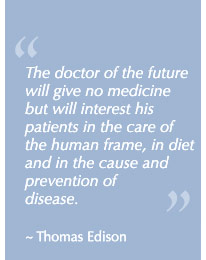
I often tell my patients that the more they do at home, the less time they’ll need to spend at the clinic.  YOU are the most important person in your recovery.  From rehab exercises to nutritional changes to activity modification, the decisions you make in the 166.5 hours/week outside the clinic are going to greatly speed or slow your progress.

A few years ago, I wrote a post called ‘I Am a Chiropractor’ that tried to explain what it is that I actually do during the day-ins and day-outs of my practice.  That post was well received by my colleagues and patients alike, and is still my most-read blog post to date.  Today’s post is another attempt at explaining where my priorities as a healthcare professional lie.

I want you to be an active participant in your recovery.

I want to help you heal faster.

We’re in this together.

Leonardo-Da-Vinci-Vitruvian-Man


Concussion in Sport

I recently attended a conference on concussion management and I learned a lot.  No, make that a LOT lot.  Concussion research has progressed dramatically since I graduated eight years ago, and there’s a void in proper concussion management amongst the sports medicine community.  The conference I attended is hoping to change that.

ccm-logo-v2

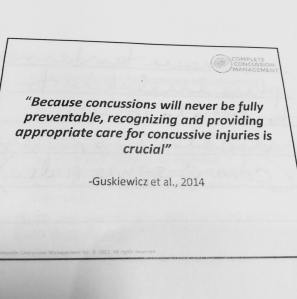
Let me change your thinking for a minute.  You’ve likely been told that a concussion is a coup/contracoup injury, meaning the brain bounces against the front of the skull, then the back of the skull, creating an injury.  Research shows that is not the case.  In fact, a concussion is actually a stretch/sheer injury of the brain’s white matter (the neuron’s axons), causing biochemical changes within the brain cell.  That’s why most concussions show no brain damage on CT or MRI.  Concussions are a temporary, recoverable injury.  Hmmmm…..

Here’s the thing with concussions.  They’re under-reported because players do not want to be taken out of the game.

Here’s the other thing:  the brain’s most vulnerable period is in the time period immediately following a concussion, so not pulling a player from the game and subsequently providing a thorough return-to-play protocol is dangerous.   In fact, the research suggests that there is no cumulative effect of concussions, so long as the player has completely recovered from the initial concussion (Eckner et al., 2011).

So how do we safely manage concussion in sport?  

Well, pre-injury baseline testing can certainly help.  Since symptoms alone are a poor indicator of an athlete’s concussion healing, baseline testing allows us to measure many things (balance, reaction time, cognitive ability, memory, visual processing, capacity, etc) and compare the results post-concussion to a pre-injury ‘normal’ state.

Imagine this common scenario:  a 13-year old gets concussed in a hockey game.  Seven days later, they are feeling good and feel ready to return to the ice.  The child is adamant- no headaches, no dizziness, no concentration problems.  So how do we know they’re safe to return?  Well, let’s see how their balance compares to their ‘normal’…. their reaction time…. their memory.  Let’s make sure that we test several areas of brain function to be sure we’ve passed that dangerous vulnerable period (Lazzarino et al., 2012).  Let’s be as sure as the latest research allows us to be.

Screen Shot 2014-10-20 at 1.49.03 PM

In fact, it’s my hope that standardized baseline testing becomes mandatory for all children in all sport.  It’s time.

1555462_610051039107167_7202556248836734029_n


Burlington Sports & Spine Clinic is a part of the Complete Concussion Management network of clinics across Canada.
Give us a call to schedule your organization for baseline testing.


“You’re Not Ready Yet”

An athlete who returns to training fearful about re-injury is an athlete that is more prone to re-injury.

Think about that statement for a minute.  Now why would I choose to write about this topic?  Because it’s something that I deal with almost daily in my practice.  If you are reading this as a patient, perhaps you can relate, and if you are reading this as a practitioner that works with athletes, most certainly you can relate.

photo-13

My knee surgery- March/2005

But, you see, this is one of the reasons that I LOVE working with athletes… I love their I-cannot-rest-I-need-to-get-back-to-training attitude.  Because I’m like that too.  I’m one of them.  I’m the basketball player who broke her thumb and finished the tournament (ask my parents).  I’m the ball-hockey player who tore her ACL and kept training for a marathon (ask my friends).  I’m the runner who sprained her ankle, taped it up, and competed anyways (ask my husband).  Were these smart decisions?  Probably not.  Would I choose differently now?  Also probably not.

But….. and this is a big but, a huge however, and an extreme nonetheless…. getting back to training before your injury is healed is not the best choice in the long run.  Let me say that again in a different way: if you injure a structure in your body and that structure is not healed before you resume training, you will re-injure yourself.  And, most likely, it’ll be worse the second time around.

That’s where the fear component comes into play.  Remember my original statement?  An athlete who returns to training fearful about re-injury is an athlete that is more prone to re-injury.  I believe that athletes know their bodies far better than I, their healthcare practitioner, do.  Sure, I know the anatomy, I understand the biomechanics, and I can draw upon research studies and my professional experience, but I don’t really know what they’re feeling.

I’m not referring to their fear of the consequences of re-injury (ie. the baseball player who worries about missing the rest of his season, the Crossfitter who worries about completing the next Open workout, the runner who worries about finishing her next marathon)- those are normal, understandable, expected fears.  I am talking about the fear, the apprehension, the tentativeness, the uneasiness, the doubt that can creep in under the surface of it all and whisper to the athlete “you’re not ready yet.”  That’s where re-injury happens.

To my athletes: if I give you the green light to resume training and fear murmurs “you’re not ready yet,” tell me.  And I will agree.

everyday get better